How the SIP provisioning engine works
The SIP provisioning engine allows you to create connectors and synchronizations to update data in the target application.
A connector is an automatic connection link between two applications, also known as repositories.
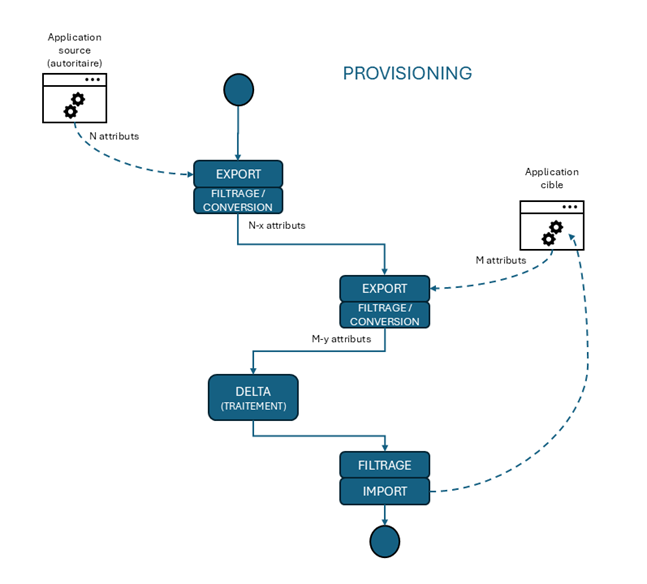
Creating a connector actually consists of creating a sequence of several actions.
A typical sequence consists of:
- 1 export rule from the source repository, known as the “authoritative” rule.
- 1 export rule from the target repository.
- Since each export is based on a repository, it is necessary to configure the repositories to define the connection criteria for the applications.
- 1 synchronization rule: definition of the comparison rules between the two exports to determine the updates to be made: creation, modification, or deletion.
- 1 import rule: writing the delta (result of the synchronization rule) according to the actions to be performed:
- If data is found in the source repository but not in the target repository, then a creation can be performed.
- If data is found in the source repository AND in the target repository, then a modification can be performed.
- If data is not found in the source repository but is found in the target repository, then a deletion can be performed.